


What ERCOT data provides
ERCOT publishes operational and wholesale market data for the ERCOT power system. This includes day-ahead and real-time market prices, locational marginal prices, settlement point prices, ancillary service prices, load and load forecast data, generation data, market disclosures, and binding transmission constraints.
Price data is available across electrical buses, resource nodes, load zones, and trading hubs. ERCOT also releases selected market disclosure reports after defined publication delays.
Source links:
- ERCOT Market Information
- ERCOT Market Prices
- ERCOT Real-Time Market
- ERCOT Day-Ahead Market
- ERCOT Market Reports
Data types covered:
Day-ahead and real-time prices, LMPs, settlement point prices, ancillary service prices, load and load forecasts, generation, market disclosures, transmission constraints.
Update frequency:
Varies by data product, from near real-time for selected real-time market data to daily day-ahead results and delayed disclosure releases, including 2-day and 60-day reports.
Connection requirements:
ERCOT API Explorer account, Public API subscription, and subscription key for API-based collection. Requirements can vary by data product.
Common use cases for ERCOT data:
- Real-time market monitoring
- Day-ahead market analysis
- Price and congestion analysis
- Forecasting and trading support.

Shooju connect to the data source you need either via one of 320+ prebuilt processors or set up a new one.
Shooju tailors the collection strategy to each dataset and business need. Critical data can be collected with near-real-time access where the source supports it, while broader datasets can run on a scheduled cadence with an appropriate embedded delay.
Here is how the process works for adding new data source to you new or existing energy data pipeline:
1. You send a new processor request to Shooju
2. Shooju evaluates the access method, format, update schedule, and downstream workflow before configuring the pipeline.
3. It usually takes from 2 to 8 days to scope, develop/adjust and set up a processor for data source you need.
4. Once connected, Shooju monitors ongoing ingestion, handles changes or failures, maintains the pipeline as part of managed delivery.

Normalization and metadata enrichment
Shooju maps source data into its proprietary data infrastructure and enriches it based on how your business uses it.This can include products, units, locations, zones, assets, timestamps, report dates, and internal naming conventions, so data can be used consistently across workflows.
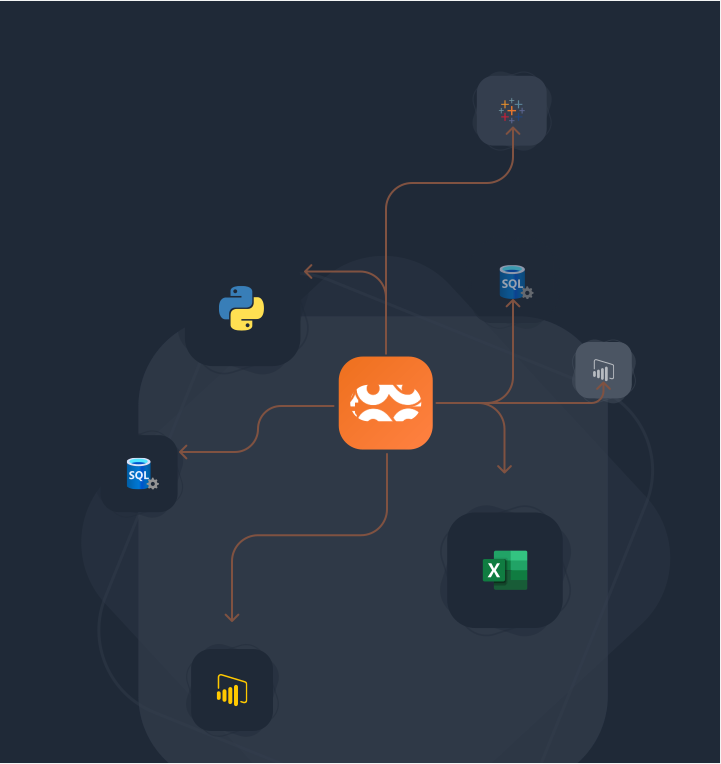
Where the data can be delivered
- Excel Add-in
- REST API
- Python
- PowerBi
- Snowflake/customer database
- internal systems
- Shooju Views / dashboards
What Shooju does not do

Related data sources

MISO
CAISO
PJM
ERCOT


EIA
